.jpg)
.jpg)
.jpg)
.jpg)
.jpg)
.jpg)
.jpg)
.jpg)
.jpg)
.jpg)
We'll be back in a bit !
The system is currently undergoing a routine upgrade to ensure you get the best learning experience. The maintenance is expected to continue till 8:00 pm. Please check back later.
Thank you for your understanding!


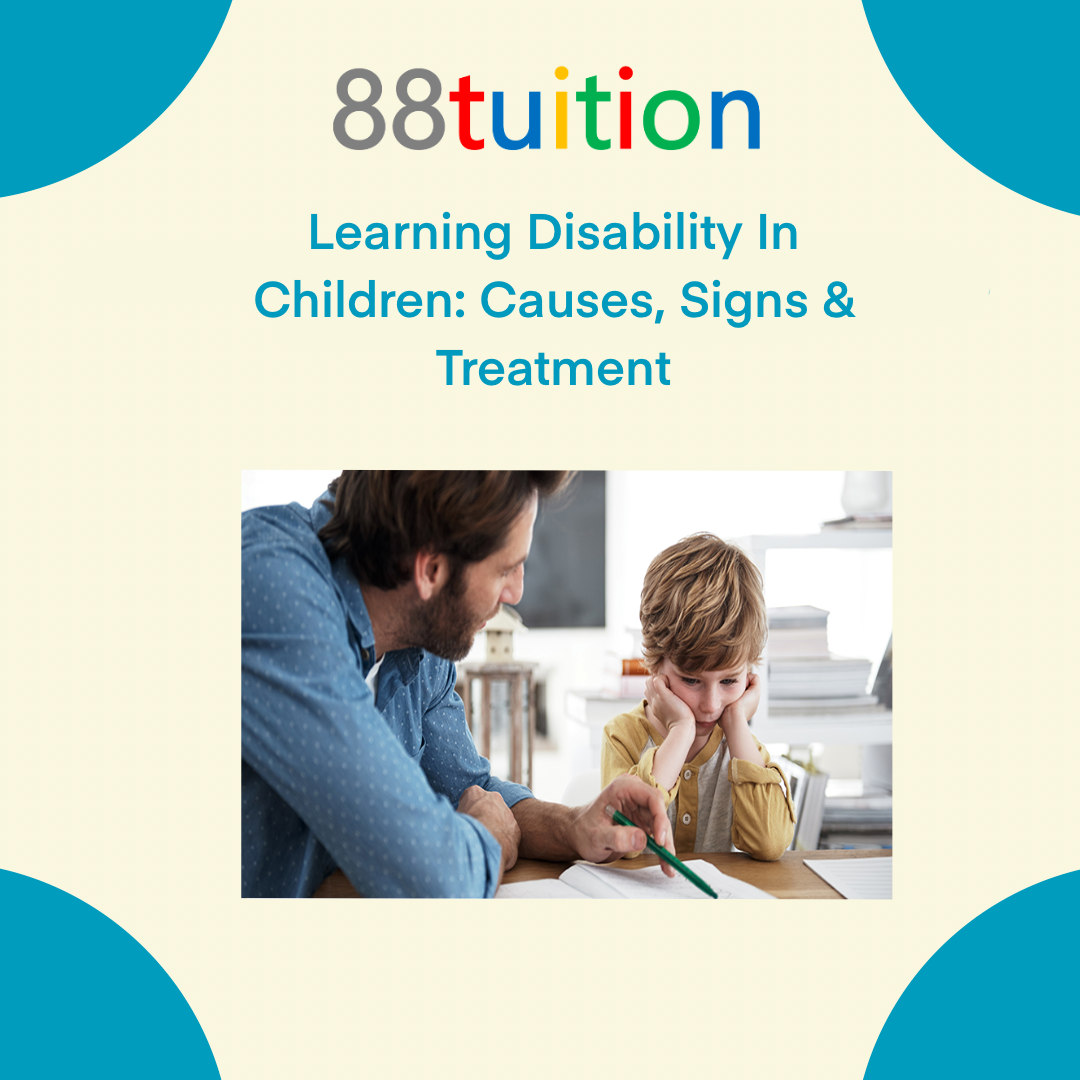
A parent wishes that their child succeed in their academic career. Some children face academic challenges due to learning disabilities. These learning disabilities in children affect their ability to perform specific tasks. In this article, we will examine the causes, symptoms, types, early detection and treatment options for children with learning disabilities. We will also see how online PSLE tuition can help Singapore children with learning disabilities.
Learning disabilities affect one's ability to learn, understand and process or remember some information. Children with these disabilities also face challenges in performing basic tasks, such as paying attention, calculating, making movements, understanding information, focusing, reading or even speaking at times. Some children also require support in all areas of their lives to perform tasks. Different groups have different definitions of learning disabilities.
At some point, all children experience challenges in learning and excelling academically. But when you see a symptom in your child that lasts for 6- 9 months and doesn't get better with the help and support from parents or adults, a child may have a learning disability.
Difficulty in reading, spelling and writing at the expected age and grade.
Having problems with remembering.
Difficulty in following and understanding any given instructions
Difficulty in time management or organizing
Not able to perform basic tasks, such as holding a pen, walking properly or speaking.
Poor focus and attention span.
Inability to differentiate between sounds, numbers or alphabets.
Poor coordination between the legs and hands.
Difficulty between similar numbers or words like 6 and 9, bat and bad, B and D etc.
Confusion between directions like 'left' and 'right'
Delayed speech development
Acting out or showing high emotions at small things
Difficulty in reading time.
Writing A, B, C, D... in reverse.
Restlessness, Clumsiness or Impulsiveness
Responding with something else when asked something
Difficulty in expressing thoughts and emotions.
Each type of learning disability has its unique signs. A person with a learning disability may or may not have all the signs mentioned above. These signs can not precisely determine that a person even has a learning disability. To be certain, consult with an expert.
There are a lot of causes of learning disabilities, including genetics, brain development and environmental factors. Here are some of the causes of learning disabilities: -
Learning disabilities can also be inherited. If any parent or blood relative has a learning disorder, they can pass on the risk of learning disabilities to their children.
It can also arise due to problems with the way the brain functions or makes movements. Complications that block the flow of oxygen to the brain can also be a factor in developing learning disabilities in children.
Premature Birth, low birth weight and exposure to toxins very early in life or before being born.
If a child goes through a deeply stressful experience or emotional abuse early in childhood, they are at risk of developing learning disabilities. Head injury can also be a factor.
There is a larger risk of developing learning disorders if a child has exposure to high levels of toxins such as lead.
"Learning disabilities" include many types of specific learning disorders. It can be mild, moderate, severe, or profound but they are all lifelong. These are the different types of learning disorders:
This is the most common type of learning disability. It is a disorder of language processing characterized by difficulty in reading, writing, and speaking words.
A person's vocabulary greatly influences their grammar, punctuation and other language aspects.
Sometimes, dyscalculia is also known as "math dyslexia." Dyscalculia includes disorders related to mathematics, calculation, concepts and reasoning. They may also struggle with counting money, addition, subtraction, formulas, etc.
People with dysgraphia face difficulty in putting their thoughts into writing because they have issues with writing, vocabulary, grammar, memory and thinking. Symptoms of this condition are poor handwriting as the person with dysgraphia struggles with spatial awareness, letter spacing and motor planning. So they can not think and write simultaneously.
Children with APD have difficulty separating certain sounds. Their brain misinterprets the auditory information that is received by the ear. So, they confuse different sounds coming at the same time and the order of sounds in particular words.
This is a subset of APD. A significant symptom of APD is difficulty in processing spoken language. A person with APD has difficulty attaching meaning to sound groups that represent words, stories and sentences.
A sign of children with NVLD is that they have trouble getting some non-verbal cues, such as facial expressions, body language, tone of voice and other non-verbal signals.
Children who have a visual motor deficit condition struggle with hand-eye coordination and motor skills. They also lose focus while reading, get confused between similar-looking alphabets and have difficulty using basic things such as pens, pencils, glue and scissors.
There are different types of learning disorders that range from mild, moderate, severe and profound. Children with such learning disorders are also at greater risk of specific conditions than other kids. Some more types of learning disabilities are:
Autism
Challenging behaviour
Cerebral palsy
Down Syndrome
Fragile X syndrome
Williams Syndrome, etc.
Diagnosing learning disabilities in children is a multi-step process that makes sure that the challenges and symptoms are identified accurately. Then, appropriate support can be provided to the child accordingly. Here is how the diagnosis works:
Observation of consistent difficulties
Parents and teachers notice continuous challenges in writing, reading, following instructions or low attention span, even though the child is making efforts to do so. Early recognition of this pattern can help.
Developmental and Educational History
Doctors and Psychologists will review the child's medical history and school performance to determine if the difficulties are consistent and persistent across various environments and over time.
Standardized Testing
Comprehensive assessments using standard tools are conducted by psychologists and specialists. The tests assess IQ, cognitive abilities, academic skills, memory, attention, processing speed and other related areas.
Eliminating Other Reasons
It is essential to be sure that vision or hearing problems, emotional concerns or other medical issues are not the only primary causes of learning disabilities.
Communication with the School
Teachers often provide valuable insights through classroom observations and academic performance records, which help in understanding and analysing how the child learns and where significant difficulties arise.
Formal Diagnosis
A specialist like a psychologist or pediatrician can diagnose dyslexia, dyscalculia, dysgraphia and non-verbal learning disabilities.
Early and accurate diagnosis can help in:
Tailoring learning strategies to the child's specific needs
Accessing school-based support services and accommodations
Building confidence and reducing frustrations in learning.
Early treatment is important for learning disabilities because the problem can also grow. They are lifelong conditions but with the help of proper care and treatment, children can manage their symptoms and also succeed in school. Some treatment options for learning disabilities in children include-
Schools can provide special education programs for children with disabilities. These facilities are designed specially for each child and they can also be modified according to their needs.
Educational Therapy also helps children develop the skills they need to succeed in school. Tutoring and training are also a part of educational therapy.
In some of the cases, medicines help manage the symptoms of learning disabilities. But medication should only be used under the guidance of healthcare professionals.
In Singapore, the PSLE is considered the main exam because it determines a child's future educational opportunities and college admission. PSLE online tuition helps these children in preparing for the exam and achieving academic success in their careers so that they can get into the college they want to.
Online PSLE tuition helps children receive personalised instruction from tutors in a comfortable environment. It is according to each child’s specific needs to make sure that they receive the help they need.
The top five most common types of learning disabilities are:
Dyslexia
Dyscalculia
Dysgraphia
APD (Auditory Processing Disorder)
LPD (Language Processing Disorder)
A professional evaluation and knowledge of those particular difficulties are necessary to know if a child actually has a learning disability. You can look for certain early indicators like reading, writing, having problems in maths and issues with focusing on one thing. If these difficulties last more than 6 months or if you can see that it is not normal, it is important that you contact a consultant.
No. ADHD is not considered a learning disability because it does not impact academic challenges directly. Hyperactivity and attention span are impacted by this neurodevelopmental disorder.